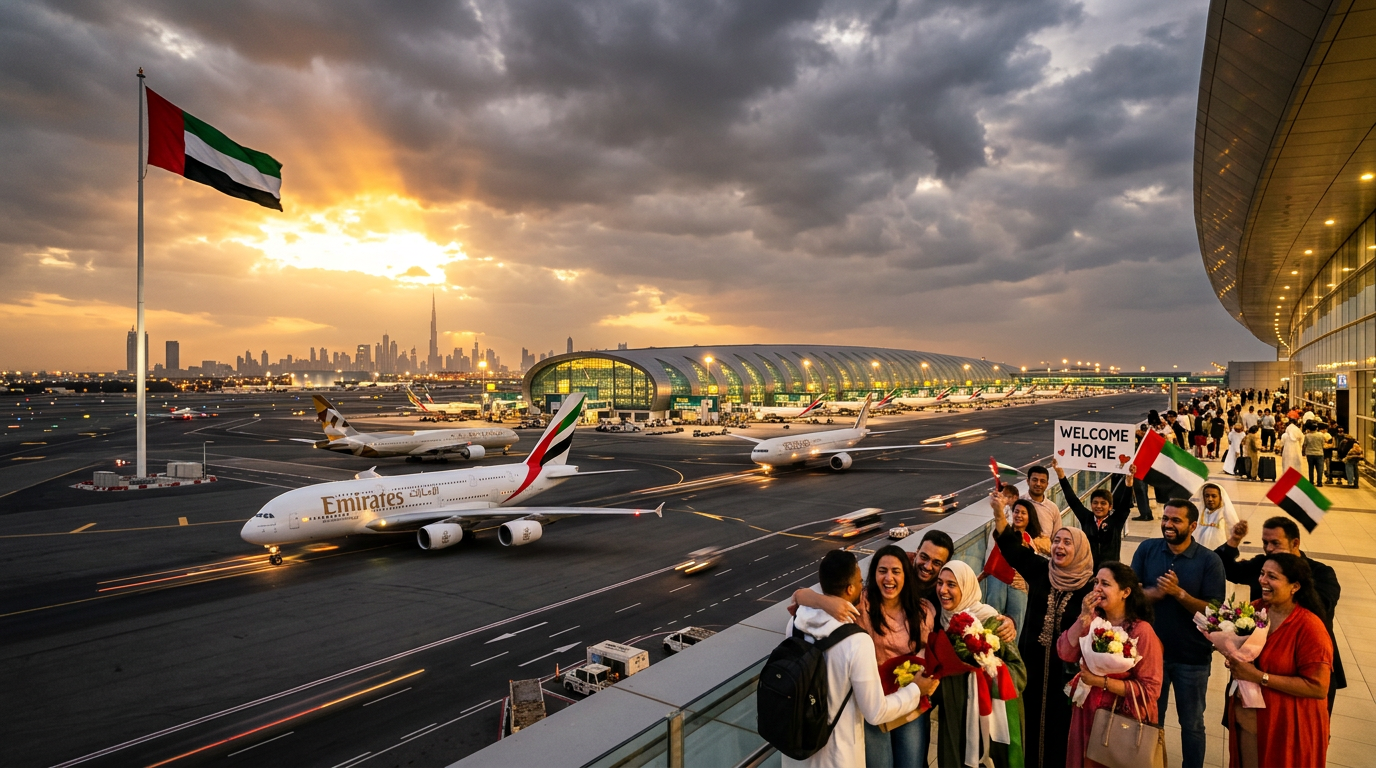
Middle East Tensions: UAE Reopens Airspace After Brief Closure, Flights Gradually Resume
If you are planning to fly into or out of the UAE today, you need to read this. Amid rapidly escalating Middle East tensions, the United Arab Emirates took the unprecedented step of briefly closing its airspace to ensure the safety of passengers and infrastructure.
The good news? The UAE reopens airspace following a comprehensive security assessment, and flights are slowly getting back on track. Here is everything you need to know about what happened, the current status of Dubai airports, and what it means for your travel plans.
What Triggered the Sudden Airspace Closure?
The closure wasn’t just a random delay. It was a direct, exceptional precautionary measure in response to severe regional threats.
- Drone and Missile Interceptions: The UAE military activated its advanced air defense systems to intercept incoming drone and missile threats originating from Iran.
- Infrastructure Impact: A drone incident triggered a fire near a fuel tank at Dubai International Airport (DXB), while another strike affected an oil field in Abu Dhabi. Emergency teams contained both situations swiftly, with zero casualties reported.
- The Reaction: To safeguard civilian aircraft and passengers, the General Civil Aviation Authority (GCAA) immediately ordered a temporary, full suspension of air traffic.
he Current Situation: UAE Reopens Airspace
Breathe a sigh of relief! After a tense few hours, the GCAA officially announced that air navigation has returned to normal across the UAE.
However, “open” does not immediately mean “back to normal.” The brief shutdown caused a massive backlog at some of the world’s busiest transit hubs.
📍 Dubai International Airport (DXB) & Al Maktoum (DWC)
Operations have partially resumed. However, authorities are stressing that the airports are functioning at a reduced capacity while airlines scramble to untangle the logistical web of diverted and delayed flights.
📍 Zayed International Airport (Abu Dhabi)
Flights are gradually taking off and landing again, but travelers should expect residual delays throughout the week.
How Are Major Airlines Responding?
The brief shutdown forced airlines to divert planes mid-air and cancel dozens of scheduled departures. Here is where the major carriers stand right now:
- Emirates: Dubai’s flagship carrier has restarted a limited flight schedule. They are actively re-accommodating passengers whose flights were canceled. If your flight was scrapped, you will receive a cancellation notice via email or SMS.
- Flydubai: Operating on a reduced schedule. They are directly contacting impacted customers.
- Etihad Airways (Abu Dhabi): Operating flights but adjusting schedules based on real-time airspace security.
- International Carriers: Some global airlines, such as British Airways, have temporarily suspended flights to specific UAE hubs due to the ongoing regional uncertainty.
Crucial Advice for Travelers Right Now
If you have a ticket booked for the next 48 hours, do not rush to the airport. Chaos at the terminals will only cause more frustration. Follow these three golden rules:
- Check Your Flight Status Online: Before you even pack your bags into the car, check your airline’s official app or website.
- Wait for Confirmation: Dubai Airports has explicitly urged passengers not to travel to DXB or DWC unless they have been directly contacted by their airline with a confirmed departure time.
- Update Your Contact Info: Ensure your email and phone number are correct in your booking portal so you don’t miss sudden gate changes or cancellation alerts.
- What’s Next?
- While the UAE reopens airspace, the GCAA has confirmed that they are maintaining “continuous real-time monitoring” of the skies. The safety of passengers remains the absolute highest priority. It may take several days for flight schedules to completely normalize, so flexibility and patience are your best tools right now.